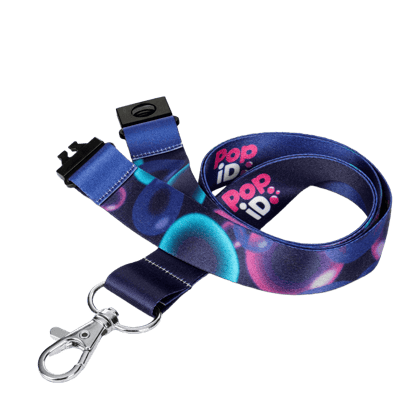

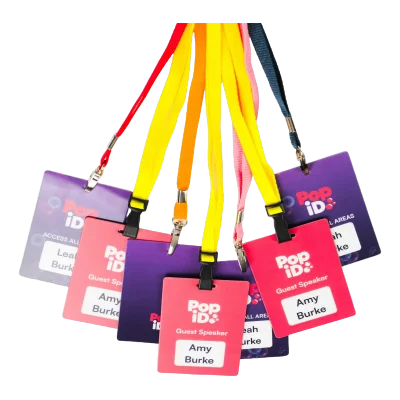
School lanyards serve one primary purpose: making it immediately obvious who belongs in the building and what their role is. In an era where safeguarding is rightly taken seriously, that matters.
Here’s a practical guide for Irish schools and colleges thinking about implementing — or upgrading — their lanyard system.
Why Schools Use Lanyards
The core reason is safeguarding. Tusla’s Child Safeguarding guidelines emphasise that schools should have clear procedures for identifying staff, visitors, and contractors on school grounds. A colour-coded lanyard system is one of the simplest ways to do this.
When every adult in the building wears a lanyard, a person without one stands out immediately. That’s the point. It’s not about paranoia — it’s about having a visible, low-effort system that makes everyone a bit more aware of who’s around.
Beyond safeguarding, lanyards also help with:
- New staff and substitutes knowing who to ask for help (look for the green lanyard — that’s the year head)
- Visitors being immediately identifiable to students and staff
- Emergency evacuations — roll call is easier when you can spot staff by lanyard colour
- General professionalism — it signals that the school takes security seriously
Colour Coding: Keep It Simple
The most effective school lanyard systems use three to five colours. Any more and people can’t remember what each one means.
A typical setup:
| Colour | Role |
|---|---|
| Blue | Teaching staff |
| Green | Support staff (SNAs, caretakers, admin) |
| Red or orange | Visitor (temporary) |
| Purple | Student teacher / trainee |
| Yellow | Contractor |
Some schools add a separate colour for management or for specific roles (resource teachers, guidance counsellors), but honestly, simpler is better. The goal is that anyone — including students — can glance at a lanyard and know the person’s general role.
Post the colour code on a sign at reception so visitors understand the system when they arrive.
Breakaway Clasps: Required, Not Optional
In a school environment, breakaway lanyards are essential. Children (especially younger ones) grab things. Lanyards get caught in doors, on furniture, in playground equipment.
A breakaway clasp releases under pressure so the lanyard comes apart instead of causing injury. For primary schools, this is absolutely non-negotiable. For secondary schools and colleges, it’s strongly recommended.
We supply all school lanyards with breakaway clasps as standard. The cost difference is genuinely negligible — we’re talking a few cents per unit.
Staff Lanyards
For permanent staff, you want lanyards that are durable enough for daily use over a full school year (and ideally longer). Dye-sublimation on polyester is the standard — it’s comfortable, the print doesn’t fade, and it holds up well to daily wear.
What to include on staff lanyards:
- School crest or logo — Identifies the wearer as belonging to your school
- School name — Useful when staff attend inter-school events or meetings
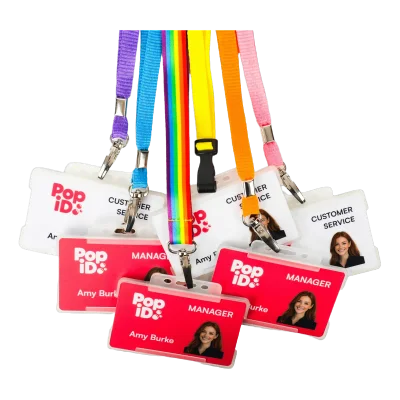
- Role colour — The lanyard colour itself communicates the role
What you don’t need: the person’s name (that’s on the ID badge in the card holder), the school phone number, or the school motto. Keep the lanyard clean and simple.
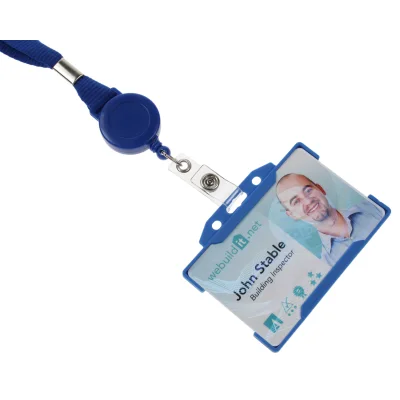
For ID badges, you can either use printed plastic cards (we do those too — see our plastic cards) or laminated paper inserts in a clear card holder. Plastic cards look more professional and last longer. Laminated inserts are cheaper and easier to produce in-house when new staff join mid-year.
Student Lanyards
Some secondary schools and most third-level colleges issue lanyards to students, usually to carry a student ID card.
For students, the key considerations are:
Durability — Students are not gentle with their belongings. Woven lanyards are the most durable option, but dye-sub polyester holds up well enough for a school year. Budget accordingly — plan for some replacements.
Breakaway — Yes, even for older students. It’s a safety standard.
Design — Students are more likely to actually wear their lanyards if they don’t look terrible. A well-designed lanyard in school colours with a clean logo works better than a cheap-looking one with clip art.
Cost — At student quantities (potentially hundreds or thousands), the per-unit cost drops significantly. For a secondary school of 800 students, dye-sub lanyards with a card holder can come in at well under two euro per student.
Some schools charge students for their lanyard and ID card as part of the start-of-year fee. Others absorb it. Either way, it’s not a large expense per head.
Visitor Lanyards
Every school should have a system for identifying visitors. A set of brightly coloured visitor lanyards kept at reception is the simplest approach.
How it works: Visitor signs in at reception, receives a visitor lanyard (orange or red — something clearly different from staff/student colours), wears it for the duration of their visit, and returns it when they sign out.
Reusable vs disposable: For most schools, reusable lanyards are fine. Keep a set of 10-20 at reception. They’ll go missing occasionally — that’s normal, just reorder when you’re running low.
What to print: “VISITOR” in large text. That’s it. You want it readable from across a corridor. School logo is optional but nice.
Tip: Number your visitor lanyards (Visitor 1, Visitor 2, etc.) and record the number in your sign-in book. It helps track who has what and makes it obvious if one hasn’t been returned.
Tusla Compliance and Best Practice
Tusla’s guidance on child safeguarding doesn’t prescribe specific lanyard requirements, but it does require schools to have policies for managing visitors and identifying adults on school grounds. A lanyard system is one of the most practical ways to demonstrate compliance.
When Tusla or the Department of Education inspects your school’s safeguarding procedures, being able to point to a visible identification system is a positive. It shows you’ve thought about it.
Some practical measures that support compliance:
- All adults on school grounds wear a lanyard at all times
- Visitors are always accompanied and wear a distinct visitor lanyard
- Contractors wear a different colour from staff and visitors
- The colour coding system is documented and posted at reception
- A sign-in/sign-out system operates alongside the lanyard system
None of this is complicated or expensive. It’s just about having a consistent system that everyone follows.
Budget Planning
Here’s a rough guide for school lanyard budgets:
| Item | Approximate Cost |
|---|---|
| Staff lanyards (dye-sub, breakaway, card holder) | From around 2 euro per unit |
| Student lanyards (dye-sub, breakaway, card holder) | From around 1.50 euro per unit at 500+ |
| Visitor lanyards (set of 20, reusable) | From around 50 euro |
| Plastic ID cards (staff, printed with photo) | Get a quote — depends on quantity and features |
For a primary school with 30 staff, the initial lanyard outlay is under 100 euro. For a secondary school with 80 staff and 800 students, you’re looking at a few hundred for staff and around 1,200-1,500 for students.
These are ballpark figures — every order is different. Get in touch for an actual quote.
Getting Started
If you’re setting up a lanyard system for the first time, we can help you work out what you need — quantities, colours, attachments, card holders, the lot. If you’re reordering for a system that’s already in place, even easier.
Send us your school crest and we’ll mock up a design for you to approve. Turnaround is typically one to two weeks from artwork approval.
Contact us or call (01) 200 5200. We supply primary schools, secondary schools, colleges, and universities across Ireland.
See our lanyard range and plastic card options.